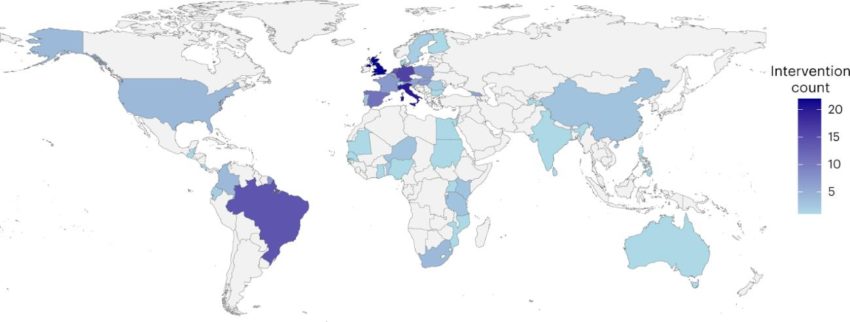
New research from a team of researchers between the Basque Centre for Climate Change (BC3), Ikerbasque, and the University of Almería explains how current NbS applied globally are addressing the CBS nexus, and whether (and how) they are promoting real long-term change when they are used to help cities adapt to climate change. (Autor: Irati…
IBM and Ikerbasque Partner to Launch Groundbreaking Quantum Computational Center
Fundación Ikerbasque, the Basque Foundation for Science in the Basque Country of Spain, and IBM (NYSE: IBM) today presented details of how they are partnering to further establish the Basque Country as a leading technology hub. This includes the adoption of quantum computing through the launch of the IBM-Euskadi Quantum Computational Center, which will provide Qiskit Runtime services from a 127-qubit IBM…
“Living Lab” is launched in New Aquitaine with the aim of promoting innovation in health.
Committed to innovation in health, the Pôle Aquitaine of the Ramsay Santé group launches its first «Living Lab», a concept aimed at experimenting in a real environment with innovative health solutions, which makes it possible to provide added value to patients as well as to Health professionals. Details with Yannick Denot, Director of Innovation, and Nicolas Bobet, Director of the Aquitaine Cluster.
“Cities are not using all the potential of nature-based solutions according to a new Basque study”.
The study conducted at the Basque Centre for Climate Change (BC3) along with the University of Almería, Sean Goodwin (BC3 and the University of Almería), Marta Olazabal (BC3 and Ikerbasque), Antonio J. Castro (University of Almería), and Unai Pascual (BC3 and Ikerbasque), has published in Nature Sustainability identifying critical pathways for making progress on the application of nature-based solutions to climate change adaptation in cities. To do so, the study has used data from 216 projects implemented in 130 cities worldwide.
Robotekin takes its first steps
The Provincial Council of Alava promotes, with the collaboration of the Basque Government, the first robotic `hub’ of Euskadi, in order to promote cooperation between companies linked to the sector and to develop the statue of Araba and Euskadi in the field. (Autor: Irati Olazabal) On February 2nd, the Araba Technology Park hosted, in the capital…
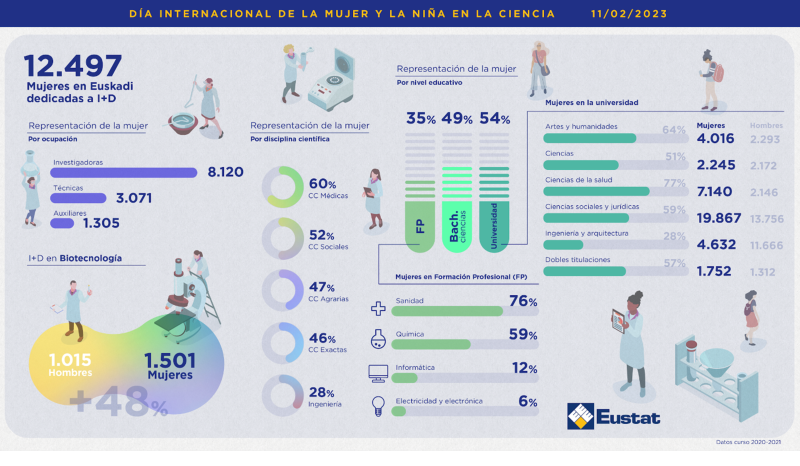
In the Basque Country, the 37.2% of the sector of the R&D are women as well as the 59.6% of all the workers in the biotechnology sector
The past 11 February was celebrated as the International Day of Women and Girls in Science so as to highlight the presence of women in the world of science. Eustat, the Basque Statistics Institute, has analyzed women’s participation in this sector using its data, both in the field of employment and in secondary and university education.
Our ‘promoproject’ begins its path today: basque.SCIENCE
International Day of Women and Girls in Science, 11. F. Innovate. Demonstrate. Elevate. Advance. Sustain.( I.D.E.A.S.) This year, the International Day of Women and Girls in Science (IDWGIS) focus on the role of Women and Girls and Science as relates to the Sustainable Development Goals (SDGs). The ‘IDWGIS’ aims to connect the International Community to…
How to detect if you have a future scientific at home?
It is popularly believed that children are born scientists. So, it is important for parents to detect this aspect and encourage their children to develop it. (Autor: Irati Olazabal) It is popularly believed that children are born scientists. This scientific ability means asking questions about the world, then creating hypotheses and collecting data to find answers. …
Maria Eugenia Martin, a Basque woman CEO and co-founder of ColorSensing
María Eugenia Martín is the CEO and co-founder of the startup ColorSensing. This develops apps based on the correction of color in digital images since 2018. Moreover, the startup has developed a multifunctional solution for food waste with the idea of intelligent packaging. She highlights the importance of women in the technological industry and states…
Researchers of the UPV/ EHU have studied how psychedelic drugs could treat psychiatric disorders
Researchers in the UPV/EHU’s (University of the Basque Country) Neuropsychopharmacology group have published a scientific paper in which the mechanism of action of the hallucinogen psilocybin in mice is studied in depth. Psilocybin is in advanced stages of clinical trials aimed at treating various psychiatric disorders such as depression or addictions. (Autor: Ane Fernandez) Psilocybin…