
Saltar al contenido
Basque Science logo
Menú
  • Home
  • About basque.SCIENCE
  • who`s who
  • Send us your proposals
Menú
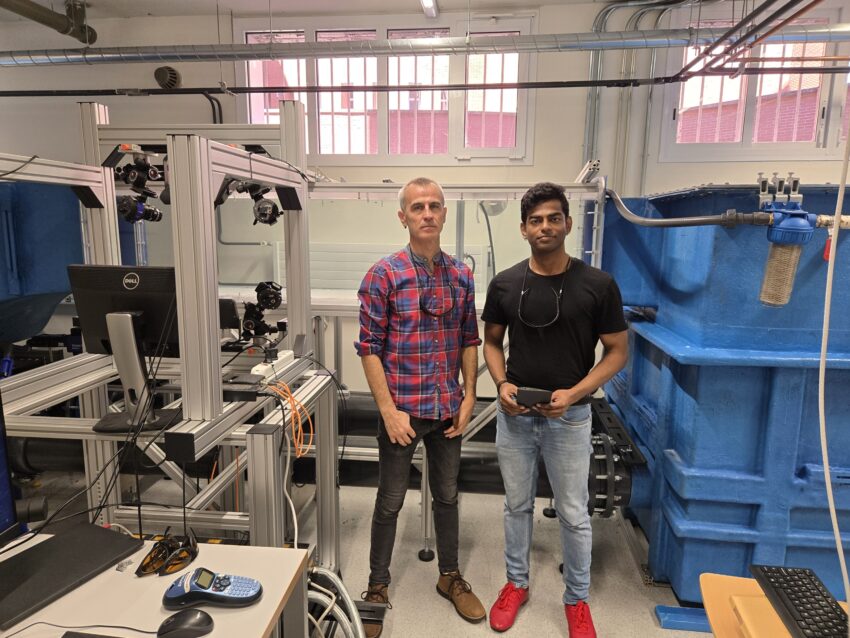
Unai Fernández Gámiz. Vivekamanickam Koothan Venkateswaran

EHU’s Renewable Energy and Green Hydrogen Lab: Powering a More Efficient, Reliable and Cost‑Competitive Future

Publicada el septiembre 20, 2026 por BasqueScience

The Renewable Energy and Green Hydrogen Laboratory (ERHV.lab) at the University of the Basque Country (EHU) is pushing the frontiers of clean energy research to make renewable generation and green hydrogen production more efficient, reliable and economically competitive.

Based at the School of Engineering in Vitoria‑Gasteiz, ERHV.lab focuses on developing renewable energy systems and studying how they can be used to produce green hydrogen at scale. Its work targets one of the hardest challenges of the energy transition: decarbonising heavy industry, storing surplus renewable electricity and replacing fossil feedstocks in applications where direct electrification falls short.

The laboratory is partially funded by the Centre for Energy, Environmental and Technological Research (CIEMAT) and brings together researchers from multiple UPV/EHU departments.


Team and mission

The lab is led by director Unai Fernández Gámiz and currently includes 12 UPV/EHU professors and 14 PhD students, plus additional master’s and bachelor’s students working on final projects. Their mission spans four core lines:

  • Optimising offshore wind and solar PV technologies for higher efficiency under real operating conditions.
  • Researching green hydrogen production from renewables to cut costs and improve competitiveness.
  • Developing models, simulations and AI algorithms to enhance the design, control and performance of energy systems.
  • Investigating energy storage solutions, such as redox flow batteries, and their integration with renewables.

In short, the lab aims to ensure that renewable power and green hydrogen become technically robust and financially viable at industrial scale.


Recent projects and breakthroughs

A recent highlight is the HIDRURA project, coordinated by Tecnalia and funded under SPRI Group’s Elkartek programme in 2024, which ended on 31 December 2025. HIDRURA explored three technological pathways to produce cheaper, more efficient and more sustainable green hydrogen: seawater electrolysis, decoupled electrolysis and biogas‑based routes. The goal was to develop components, models and prototypes that could prove industrial competitiveness.

On the modelling side, ERHV.lab has built a Computational Fluid Dynamics (CFD) model that replicates the operation of an alkaline electrolyser cell. This tool is designed to accelerate the optimisation of hydrogen production systems powered by renewables and is currently in the validation phase.

The lab is also involved in the SINTETIK project, funded by Elkartek 2025, which targets new technologies for renewable synthetic fuels (e‑fuels) and more efficient, lower‑emission hydrogen production from ammonia.


Why green hydrogen matters for Basque industry

For Basque industry, green hydrogen is not just an energy vector but a lever for competitiveness and industrial transformation. Sectors such as steelmaking, chemicals, refining, glass, cement and paper are energy‑intensive and, in many cases, difficult to electrify directly. Green hydrogen can progressively replace coal, natural gas and fossil‑based hydrogen in high‑temperature processes and as a chemical feedstock, while also enabling the production of synthetic fuels.

For society, it offers potential benefits including reduced dependence on imported fossil fuels, improved energy security and lower pollution from heavy industry and freight transport. However, the lab stresses that hydrogen is not a universal solution: electrolysis is electricity‑ and water‑intensive and entails energy losses across production, storage and use, underscoring the need for continued R&D.


Collaboration and next steps

ERHV.lab works closely with Basque research centres and technology organisations, as well as European and international universities and research groups. This network supports multidisciplinary projects, knowledge sharing and the co‑development of new energy technologies.

Positioned at the early stages of the technology development chain, the laboratory generates scientific knowledge and explores new concepts that will underpin future decarbonisation, electrification and energy system transformation in the Basque Country and beyond.

+info HERE

EBI Eficient Facilities

Rebeca Díez Alarcia
Basque Science Woman Women STEM STEAM
CIC ENERGIGUNE
Olena Kyzyma
Ildefonso Martínez de la Fuente, EHU-UPV
Natalia Andrea Romero. GIIDEBA
Basque Science Woman Women STEM STEAM
José Ignacio Zudaire
Raquel Esteban Terradillos y Daniel Marino Bilbao
Santa Águeda
Dorleta Jimenez de Aberasturi

Last News

  • EHU’s Renewable Energy and Green Hydrogen Lab: Powering a More Efficient, Reliable and Cost‑Competitive Future
  • CIC ENERGIGUNE marks fifteen years of turning scientific excellence into technology and impact for the basque country
  • New treatment target found for highly aggressive primary liver cancer
  • BIOSPAIN 2026 positions Bilbao as the European capital for biotechnology
  • July 22 marks World Brain Day
  • The Basque Country, one of the Leading Quantum Ecosystems on the International Map
  • CIC energigune drives the development of smart textiles capable of managing temperature and energy
  • LUP: Artificial Intelligence and Computer Vision for Accessible Reading
  • Onkoreplica: We seek to accelerate the development of more effective therapies and improve cancer patients’ access to treatment
  • Ylenia Jabalera and Ujué Fresán awarded the 2026 L’Oréal–UNESCO ‘For Women in Science’ prizes
  • The power of the sea drives an innovative project on the Basque coast: Carnegie commitment to clean energy
  • Cyber ​​Surgery aims to introduce its spinal surgery robot in the United States
  • Universal Omics: “It’s time to use AI to research and treat metabolic diseases”
  • Oroi Boosts Growth in Central Europe with Acquisition of Kaleido VR
  • Glycoscience develops long-lasting natural repellents and sustainable biopesticides from the Basque Country
  • The first global tool to promote equality in ocean management is launched
  • Aleovitro, Basque Biotechnology for In Vitro Plant Cultivation
  • ‘Emakumeak Zientzian’ celebrates its tenth edition with a Manifesto for the Science of the Future
  • Basque Country Showcases Quantum Strategy to 14 European Regions at Innovation Leaders Meeting
  • Women in Science in the Basque Country: A Decade of Weaving Networks​
  • A pioneering genetic catalogue reveals hidden biodiversity in Basque estuary sediments
  • A mechanism that aggravates metabolic fatty liver disease discovered
  • Basque Country strengthens its position as a European hub for biosanitary innovation, neuroscience, and health technologies after two major achievements
  • University of Deusto to build its first academic satellite in partnership with Satlantis Microsats
  • Basque Government and IBM inaugurate the first ‘Quantum System Two’ in Europe, located in Donostia
  • Aurelio Mateo Alonso appointed Corresponding Academician of the Royal Academy of Sciences
  • Supercomputing in Industry and its importance
  • Deusto researchers develop a guide to help companies measure their social value and impact
  • Bilbao: IDOM announces its Science Factory
  • Basquevolt Chosen by the European Commission’s EIC Accelerator to Drive Solid-State Electrolyte Innovation and Production ‘Made in Basque Country’ for Europe
  • How the Basque Country Is shaping the observatory will change the understanding of the universe
  • Amalur EIS: A New Platform for Evaluating Industrial Emissions Across Europe
  • New advances in the search for new medications
  • MINDSENS: Early Alzheimer’s detection with a drop of blood
  • EHU: Heart disease, cancer or Parkinson’s risk development could be found through saliva analysis
  • Clean Hydrogen Generation from Seawater
  • Neuron-like cells made from human dental stem cells
  • GLUTLEARN, an educational programme for people following a gluten-free diet
  • European cities are lagging behind in adapting to climate change.
  • LAPlab: Deciphering the secrets of language
  • MEPRO Medical Reproductive Solutions, technology with purpose: innovating in male fertility
  • The Basque Country will install the first ‘IBM Quantum System Two’ in Europe, in Donostia – San Sebastián
  • An environmentally friendly and economical high-power energy storage system from pine biomass
  • The fascinating invention to detect dark matter in Jupiter’s interior
  • Pilar Nicolás, researcher at the UPV/EHU, participates in the creation of the largest European DNA catalogue
  • Etxetar, the world’s leading engineering company in advanced production systems for combustion engine and electric vehicle parts
  • Pollinator diversity in urgent need of protection for ensure ecosystems function properly
  • Antonio Gómez Muñoz, named Honorary Member of the Sphingolipid Club
  • The Basque Country, a benchmark in neruromorphic technology
  • Bilbao presents its STEAM education strategy at the I European Congress in Göteborg

Encuéntranos

Dirección
Plaza de la Convivencia
Bilbao, 48001
BASQUE COUNTRY

info@basque.science

  • septiembre 20, 2026 by BasqueScience EHU’s Renewable Energy and Green Hydrogen Lab: Powering a More Efficient, Reliable and Cost‑Competitive Future
  • septiembre 14, 2026 by BasqueScience CIC ENERGIGUNE marks fifteen years of turning scientific excellence into technology and impact for the basque country
  • agosto 12, 2026 by BasqueScience New treatment target found for highly aggressive primary liver cancer
  • julio 24, 2026 by BasqueScience BIOSPAIN 2026 positions Bilbao as the European capital for biotechnology
  • julio 21, 2026 by BasqueScience July 22 marks World Brain Day

SCIENCE

The scientific production in the Basque Country is very relevant. The educational and university environment, the business world, entities and institutions make up an important ecosystem here that is committed to the future.

TECHNOLOGY

Technologies and good methodologies facilitate a greater and better advancement of Science. Science and Technology come together to improve the quality of life of People, to build a better society..

INNOVATION

The Basque institutional strategies for Science, Technology and Innovation work to position our region among the most advanced European regions in innovation, with an excellent Human Development Index.