
Saltar al contenido
Basque Science logo
Menú
  • Home
  • About basque.SCIENCE
  • who`s who
  • Send us your proposals
Menú
Physics Center

Discovery: The most distant dwarf galaxy detected so far

Publicada el mayo 28, 2023mayo 28, 2023 por BasqueScience

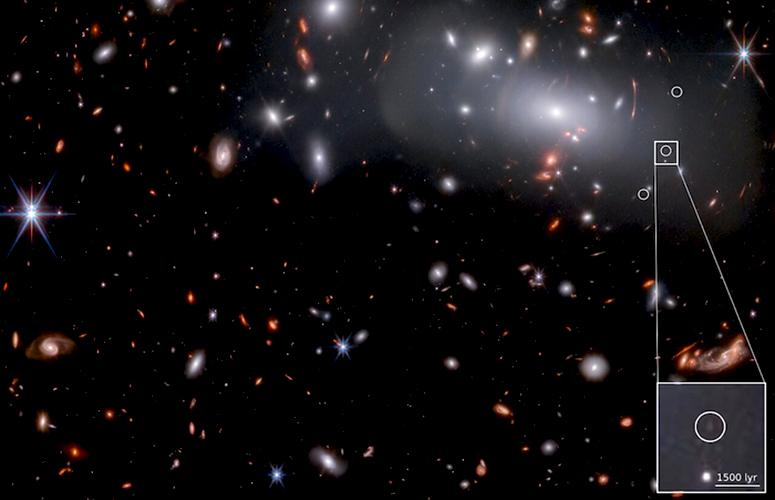
An international team, including the Ikerbasque research professor of the University of the Basque Country (UPV/EHU) and associate of  Donostia International Physics Center (DIPC) Tom Broadhurst, used the high resolution of the James Webb Space Telescope (JWST) combined with a powerful gravitational lens to conclude that the galaxies that formed in the early universe were typically very small, indicating a hierarchical process of evolution from dwarf galaxies gradually merging together as a result of mutual gravity, until massive galaxies such as our Milky Way were formed. The study has just been published in the journal Science.

By analysing the spectra of several galaxies in the distant Universe, the team was also able to confirm the detection of the most distant dwarf galaxy found to date. As Broadhurst explains, “this tiny, very low luminosity galaxy is one of the first to form, only 500 million years after the Big Bang, when the volume of the Universe was about a thousand times smaller than it is today.”

Broadhurst is part of an international team with a large allocation of JWST time for the study of stars and galaxies in the distant universe through gravitational lensing, a method that uses massive objects, such as clusters of galaxies, to magnify in brightness and size the targets behind them. Earlier this year, the team had already measured the spectrum of several stars and galaxies using this technique, “and we were very excited when we detected this very high redshift galaxy.” The latest observations enabled the team to confirm that “the distance estimate of this galaxy is 100% reliable, because we were able to recognise distinctive elements in its spectrum, such as hydrogen, carbon, oxygen and neon, which come from its hot gas.”


Lucky strike

Measurements of the size of this galaxy have revealed that it is a very low-brightness dwarf galaxy located 13.2 billion light years away. These measurements were made “thanks to the high-resolution of the James Webb Telescope combined with the magnification power of a massive cluster of galaxies located in the foreground which acts as a giant lens”, explained the professor. Broadhurst is an experienced spectroscopist and an expert in gravitational lensing, so his work has involved “interpreting the spectrum and estimating the amplification of this galaxy by using a model of the gravitational field of the large cluster of galaxies acting as a lens in this case.”

As the researcher explained, “this galaxy was not our primary target, but fortunately it appeared in the images obtained with the James Webb, so we decided to add it to our list of targets for follow-up spectroscopy.” This serendipitous discovery has led the team to conclude that “it is highly possible this type of small low luminosity dwarf galaxy is typical of the first galaxies to form in the early Universe, rather than the bright galaxies claimed by other groups that do not use gravitational lensing.”

Tom Broadhurst IKERBASQUE
organización integral de eventos y servicios de protocolo

Descubrimiento de la galaxia enana más lejana detectada hasta ahora

Un equipo internacional, del que forma parte el profesor Ikerbasque de la UPV/EHU y asociado al Donostia International Physics Center (DIPC) Tom Broadhurst, utilizó la alta resolución del Telescopio Espacial James Webb (JWST) combinada con un poderoso lente gravitacional, para concluir que las galaxias que se formaron en el universo primitivo eran normalmente muy pequeñas y que, en un proceso de evolución jerárquico, estas galaxias se fueron fusionando por gravedad mutua hasta formar galaxias masivas como nuestra Vía Láctea. El estudio acaba de ser publicado por la revista ​Science.

Mediante el análisis de los espectros de varias galaxias en el Universo lejano, el equipo ha podido confirmar además la detección de la galaxia enana más distante encontrada hasta la fecha. Según explica Broadhurst, “esta galaxia pequeña y de muy baja luminosidad es una de las primeras que se formaron, solo 500 millones de años después del Big Bang, cuando el volumen del universo era unas mil veces menor que el actual”.

Broadhurst forma parte de un equipo internacional que cuenta con una gran asignación de tiempo del JWST para estudiar estrellas y galaxias en el universo lejano a través de lentes gravitacionales, un método que utiliza objetos masivos, como cúmulos de galaxias, que magnifican en luminosidad y tamaño los objetos que se encuentran detrás. A principios de este año, el equipo ya había medido el espectro de varias estrellas y galaxias mediante esta técnica, “y nos sentimos muy emocionados al detectar una galaxia con un desplazamiento al rojo muy elevado”.  Las últimas observaciones permitieron al equipo confirmar que “la estimación de la distancia de esta galaxia es fiable al 100 %, porque hemos sido capaces de reconocer elementos distintivos en su espectro, como hidrógeno, carbono, oxígeno y neón, que provienen de su gas caliente”.


Golpe de suerte

Las mediciones del tamaño de esta galaxia han revelado que se trata de una galaxia enana de muy baja luminosidad situada a 13.200 millones de años luz. Estas mediciones han sido realizadas “gracias a la alta resolución del telescopio James Webb combinada con el poder magnificador de un cúmulo masivo de galaxias que se encuentra en primer plano, que actúa como una lente gigante”, explica el profesor. Broadhurst es un experimentado espectroscopista y experto en lentes gravitacionales, por lo que su trabajo ha consistido en “interpretar el espectro y estimar la amplificación de esta galaxia, mediante un modelo del campo gravitatorio del gran cúmulo de galaxias que actúa como lente en este caso”.

Según explica el investigador, “esta galaxia no era nuestro objetivo principal, pero afortunadamente apareció en las imágenes obtenidas con el James Webb, por lo que decidimos añadirla a nuestra lista de objetivos para una espectroscopía de seguimiento”. Este descubrimiento fortuito ha llevado al equipo a concluir que “es muy posible que este tipo de galaxia enana y poco luminosa sea típica de las primeras galaxias que se formaron en el Universo primitivo, en lugar de galaxias más brillantes como afirman otros grupos que no utilizan lentes gravitacionales”.
Physics Center
Trebeki LeQuid

José Ignacio Zudaire
Raquel Esteban Terradillos y Daniel Marino Bilbao
CIC ENERGIGUNE
Santa Águeda
Olena Kyzyma
Dorleta Jimenez de Aberasturi
Basque Science Woman Women STEM STEAM
Ildefonso Martínez de la Fuente, EHU-UPV
Basque Science Woman Women STEM STEAM
Rebeca Díez Alarcia
Natalia Andrea Romero. GIIDEBA

Last News

  • Basque Country Showcases Quantum Strategy to 14 European Regions at Innovation Leaders Meeting
  • Women in Science in the Basque Country: A Decade of Weaving Networks​
  • A pioneering genetic catalogue reveals hidden biodiversity in Basque estuary sediments
  • A mechanism that aggravates metabolic fatty liver disease discovered
  • Basque Country strengthens its position as a European hub for biosanitary innovation, neuroscience, and health technologies after two major achievements
  • University of Deusto to build its first academic satellite in partnership with Satlantis Microsats
  • Basque Government and IBM inaugurate the first ‘Quantum System Two’ in Europe, located in Donostia
  • Aurelio Mateo Alonso appointed Corresponding Academician of the Royal Academy of Sciences
  • Supercomputing in Industry and its importance
  • Deusto researchers develop a guide to help companies measure their social value and impact
  • Bilbao: IDOM announces its Science Factory
  • Basquevolt Chosen by the European Commission’s EIC Accelerator to Drive Solid-State Electrolyte Innovation and Production ‘Made in Basque Country’ for Europe
  • How the Basque Country Is shaping the observatory will change the understanding of the universe
  • Amalur EIS: A New Platform for Evaluating Industrial Emissions Across Europe
  • New advances in the search for new medications
  • MINDSENS: Early Alzheimer’s detection with a drop of blood
  • EHU: Heart disease, cancer or Parkinson’s risk development could be found through saliva analysis
  • Clean Hydrogen Generation from Seawater
  • Neuron-like cells made from human dental stem cells
  • GLUTLEARN, an educational programme for people following a gluten-free diet
  • European cities are lagging behind in adapting to climate change.
  • LAPlab: Deciphering the secrets of language
  • MEPRO Medical Reproductive Solutions, technology with purpose: innovating in male fertility
  • The Basque Country will install the first ‘IBM Quantum System Two’ in Europe, in Donostia – San Sebastián
  • An environmentally friendly and economical high-power energy storage system from pine biomass
  • The fascinating invention to detect dark matter in Jupiter’s interior
  • Pilar Nicolás, researcher at the UPV/EHU, participates in the creation of the largest European DNA catalogue
  • Etxetar, the world’s leading engineering company in advanced production systems for combustion engine and electric vehicle parts
  • Pollinator diversity in urgent need of protection for ensure ecosystems function properly
  • Antonio Gómez Muñoz, named Honorary Member of the Sphingolipid Club
  • The Basque Country, a benchmark in neruromorphic technology
  • Bilbao presents its STEAM education strategy at the I European Congress in Göteborg
  • ‘Emakumeak Zientzian’: Basque Women in Science
  • Golden Gait helps Parkinson’s patients improve mobility
  • From Lab to Field: The startup revolutionizing sports nutrition
  • Casilda Iturrizar: A feminist legacy rescued by science
  • BILBAO HOSTS THE VII RSME CONGRESS OF YOUNG RESEARCHERS
  • The level of agreement among different nutrition labels worldwide is very low
  • Polykey provides polymer solutions for a more sustainable future
  • DIVE Medical helps diagnose visual and neurocognitive problems in childhood
  • Asparia Glycomics leads the market in glycans, essential molecules for diagnosing and curing multiple diseases
  • Jaime Martin, the Basque scientist who is researching organic solar cells in Galicia
  • One hundred and sixty-two people from the University of the Basque Country, among the most influential in the world of science
  • The Basque Hydrogen Corridor, one of the world’s main H2 valleys
  • Giideba, innovative technology to prevent and treat bedsores and venous thrombosis
  • This is LUR-1, the first 100% Basque satellite launched by AVS
  • AI detects cancer and viral infections with nanometre precision
  • Qassay develops medical readers for diagnosing diseases such as cancer or diabetes
  • 3R Technology to build lighter and more sustainable trains
  • Innitius: an AI capable of improving the health and quality of life of pregnant women and newborns

Encuéntranos

Dirección
Calle Principal, 123
Madrid, 28000

Horas
Lunes a viernes: de 9:00 a 17:00 h.
Sábado y domingo: de 11:00 a 15:00 h.

  • febrero 9, 2026 by BasqueScience Basque Country Showcases Quantum Strategy to 14 European Regions at Innovation Leaders Meeting
  • enero 20, 2026 by BasqueScience Women in Science in the Basque Country: A Decade of Weaving Networks​
  • enero 12, 2026 by BasqueScience A pioneering genetic catalogue reveals hidden biodiversity in Basque estuary sediments
  • diciembre 16, 2025 by BasqueScience A mechanism that aggravates metabolic fatty liver disease discovered
  • diciembre 5, 2025 by BasqueScience Basque Country strengthens its position as a European hub for biosanitary innovation, neuroscience, and health technologies after two major achievements

SCIENCE

The scientific production in the Basque Country is very relevant. The educational and university environment, the business world, entities and institutions make up an important ecosystem here that is committed to the future.

TECHNOLOGY

Technologies and good methodologies facilitate a greater and better advancement of Science. Science and Technology come together to improve the quality of life of People, to build a better society..

INNOVATION

The Basque institutional strategies for Science, Technology and Innovation work to position our region among the most advanced European regions in innovation, with an excellent Human Development Index.