
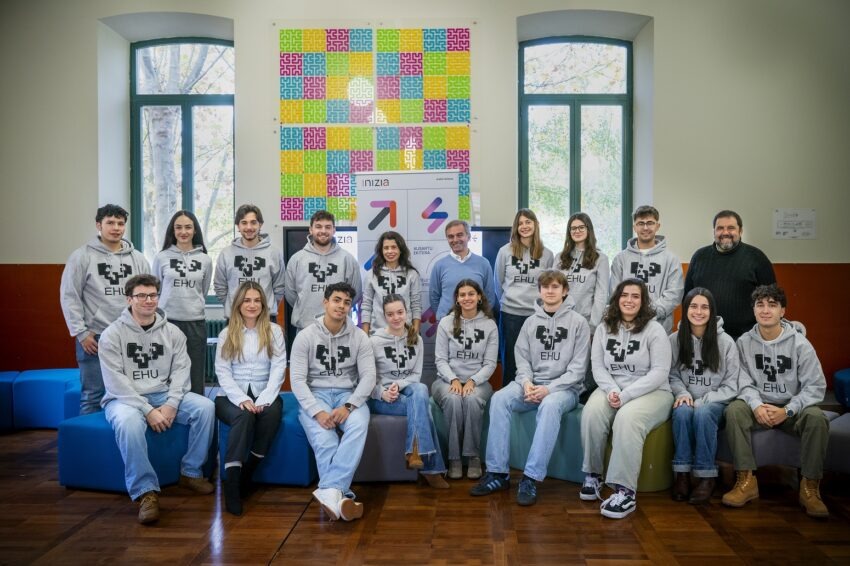
Sixteen students from the University of the Basque Country (UPV/EHU) will take part in the international workshop Design The Future – Terraforming at CERN in Geneva, Switzerland, from 15 to 20 November.
Organised as part of CERN IdeaSquare’s i2Planet 2026 educational project, the programme combines science, technology and creativity to explore the role of human and artificial intelligence in building a sustainable future. The selected students—eight women and eight men—are enrolled at the Álava Campus or, if resident in Álava, at another UPV/EHU campus.
A hands-on learning experience
The workshop aims to create links between the university community and CERN’s scientific community. Through training activities and scientific simulations, students will develop ideas and projects with a positive impact on planetary sustainability.
They will also take part in an international challenge: designing strategies for real-world problems while balancing innovation, ethics, social responsibility and sustainability. The goal is to show that both human and artificial intelligence can coexist harmoniously with the environment.
Participants are expected to strengthen skills such as critical thinking, creativity, problem-solving, innovation and entrepreneurship—key competencies for addressing today’s global challenges.
Designing sustainable solutions
Another focus will be developing innovative entrepreneurial projects based on sustainable technology, the circular economy and the UN Sustainable Development Goals. Using a “terraforming” approach, students will first imagine how to build a sustainable civilisation on another planet, then apply those lessons to challenges on Earth.
The initiative is part of the INIZIA Araba Campus programme, run with BIC Araba to support entrepreneurship and the creation of innovative, technology-based companies within the university community.
Edited by Jon Erramun Arrue-Karazo