The past 11 February was celebrated as the International Day of Women and Girls in Science so as to highlight the presence of women in the world of science. Eustat, the Basque Statistics Institute, has analyzed women’s participation in this sector using its data, both in the field of employment and in secondary and university education. (Autor: Ane Fernandez)
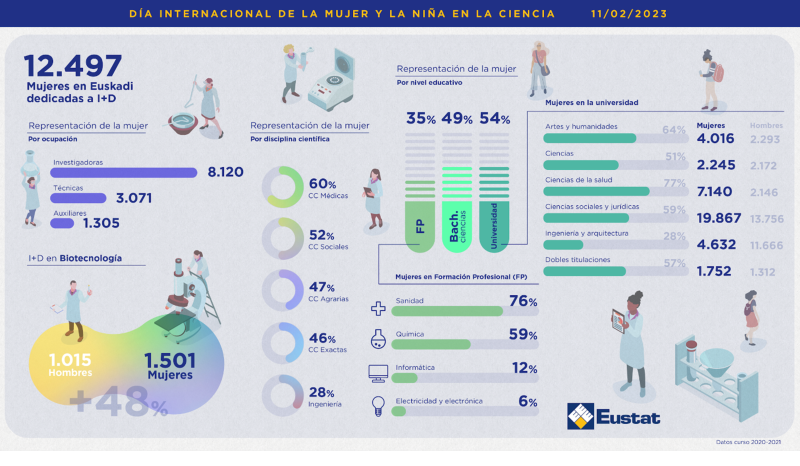
In the Basque Country, a total of 33,591 people worked in R&D in 2021, of whom 12,497 were women, according to Eurostat data. Although the presence of women in this sector has increased year after year, showing a positive evolution, women still only account for 37.2% of the total number of people employed in R&D. In the last 18 years, the presence of women has grown by 5.9 percentage points given that in 2003 women accounted for 31.3%.
Of the total, the majority of women are researchers (8,120), a figure much lower than for men, which reaches 14,074. There are 3,071 female technicians compared to 5,624 men, while in the case of assistants, the figures are similar with 1,305 women and 1,390 men.
By scientific discipline, Engineering is the activity with the highest number of workers in the field of R&D at 20,939, or 62.3% of the total. Although this field is the largest employer of women within the scientific disciplines, they only represent 27.6% of the total (5,786), much lower than men who represent 72.4% (15,153). However, the discipline where women outnumber men is that of Medical Sciences, where they account for 59.8% (2,860) of the total number of people employed, compared to 40.2% of men (1,922).
In the same vein and within the field of R&D, women outnumber men in the biotechnology sector, with 48% more female workers. There are 1,501 women in this sector (59.7% of the total) and 1,015 men (40.3%).
The majority of women studying science are enrolled in health science degrees
If we look at universities, 54% of students are women, specifically 37,900 of the total of 69,933. Of the total number of female university students, 19,867 are studying Social and Legal Sciences, which is the branch with the highest number of students, 33,623 in total.
The majority of women studying science are enrolled in Health Sciences (7,140), while this figure drops to 2,146 for men. Furthermore, Engineering, which ranks second in terms of number of students, (16,298), is one of the most male-dominated branches with 11,666 male students. Women account for 4,632 students. Finally, in the Sciences branch there is a more equal proportion of men and women, with 2,245 women and 2,172 men.
In Vocational Training, women account for 35% of students; as is also the case for university degrees, they mainly opt for the Healthcare branch (75.6%). Another of the branches with one of the highest number of students is Chemistry and, in this case women are also in the majority, accounting for 58.7%. Among the areas with the most students, the greatest differences can be found in Electricity and Electronics, where female students account for only 6.1%.
In Upper Secondary Education, there is practically the same proportion of boys and girls on the Sciences route, where girls represent 48.8%. In the case of the Humanities and Social Sciences routes, there is a greater difference, being more female-dominated options. Specifically, in Social Sciences, 57.7% of students are women and 42.3% men; while in the Humanities, the percentages are 57.7% and 42.3%, respectively.
En Euskadi las mujeres representan el 37,2 % del total de personas que trabajan en el sector del I+D, así como el 59,6% del sector de la biotecnología.
El pasado 11 de febrero se celebró el Día Internacional de la Mujer y la Niña en la Ciencia, con el fin de visibilizar la presencia de la mujer en el mundo de la Ciencia. Por ello, Eustat (Instituto Vasco de Estadística) analiza con los datos a su alcance la presencia de la mujer en este ámbito, tanto en el campo laboral como en la enseñanza secundaria y universitaria.
En la CCAA de Euskadi hay un total de 33.591 personas dedicadas a I+D (2021), de las que 12.497 son mujeres, según datos elaborados por Eustat. Si bien, la presencia de mujeres en este sector ha ido aumentando año tras año, ha tenido una evolución positiva, todavía supone el 37,2% del total de personas empleadas en la I+D. En los últimos 18 años, la presencia de la mujer ha aumentado 5,9 puntos porcentuales ya que, en 2003, las mujeres representaban el 31,3 %.
Del total de mujeres, la mayor parte son investigadoras, 8.120, un número muy inferior al total de hombres que alcanza los 14.074. Las técnicas son 3.071, frente a los 5.624 hombres, y, por último, en auxiliares, las cifras se acercan y las mujeres son 1.305 y los hombres 1.390.
Por disciplina científica, Ingeniería es la actividad donde mayor número de personas trabajan en el ámbito de la I+D, 20.939, el 62,3% del total, y las mujeres, aunque es el campo dentro de las disciplinas científicas, en la que más mujeres trabajan, apenas representan el 27,6 % (5.786) muy por debajo de los hombres, que suponen el 72,4% (15.153). Sin embargo, donde las mujeres superan en mayor medida a los hombres, en cuanto a número, es en la disciplina de Ciencias Médicas donde representan el 59,8 % (2.860) de las personas empleadas, frente al 40,2 % de hombres (1.922).
En esta línea y dentro de la I+D, destaca el sector de la biotecnología, donde son más las mujeres que trabajan en este campo, hay un 48 % más de mujeres. En este sector trabajan 1.501 mujeres (59,7% del total) y 1.015 hombres (40,3%).
Las mujeres que estudian rama científica lo hacen en su gran mayoría en grados de ciencias de la salud
Si miramos a la universidad, el 54% son mujeres, concretamente 37.900 de un total de 69.933. Si bien, del total de mujeres universitarias, 19.867 lo hacen en Ciencias Sociales y Jurídicas, que es la rama con mayor alumnado, un total de 33.623.
Las mujeres que estudian la rama científica, la gran mayoría se matricula en Ciencias de la Salud, 7.140, mientras que los hombres solo son 2.146. Así mismo, Ingeniería, que ocupa el segundo puesto en cuanto al número de alumnado, 16.298, es una de las ramas más masculinizadas con 11.666 alumnos. Las mujeres suman 4.632 alumnas. Por último, en la rama de Ciencias es donde se ve mayor paridad, con 2.245 mujeres y 2.172 hombres.
En Formación Profesional el 35 % son chicas que optan, al igual que en la universidad, por la rama de la Sanidad, el 75,6 %. Otra de las ramas con mayor número de alumnado es Química y, en este caso, también las mujeres son mayoritarias y suponen el 58,7 %. Entre las familias que tienen más alumnado, donde se aprecian las mayores diferencias es en Electricidad y Electrónica donde las alumnas apenas representan un 6,1 %.
En cuanto al bachiller, prácticamente hay la misma proporción entre chicos y chicas en el bachiller de Ciencias, las chicas representan el 48,8 %. En el caso de los bachilleres de Ciencias Sociales y Humanidades, la diferencia es mayor y están más feminizados. Concretamente, en Ciencias Sociales, un 57,7 % son mujeres y un 42,3 % hombres; en el caso de Humanidades, un 57,7 % y un 42,3 %, respectivamente.
Euskal Herrian, emakumeak I+G sektorean lan egiten duten pertsonen % 37,2 dira, baita bioteknologiaren sektorearen % 59,6 ere.
Otsailaren 11n, Emakumeen eta Nesken Zientziaren Nazioarteko Eguna ospatu zen, emakumeen presentzia Zientziaren munduan ikusgarri egiteko. Hori dela eta, Eustat (Euskal Estatistika Institutua) eskura dituen datuak erabiltzen ditu emakumeen presentzia arlo honetan aztertzeko, bai lan arloan, bai bigarren hezkuntzan eta unibertsitatean.
Eustatek landutako datuen arabera, Euskal AEn guztira 33.591 pertsona aritzen dira I+Daren arloan (2021), eta, haietatik, 12.497 emakumeak dira. Emakumeek sektore horretan duten presentziak urtez urte gora egin badu eta bilakaera positiboa izan bada ere, emakumeak I+Gan lan egiten duten pertsona guztien % 37,2 baino ez dira oraindik. Azken 18 urteetan, emakumeen presentziak 5,9 portzentaje-puntuko igoera izan du. Izan ere, emakumeak % 31,3 ziren 2003. urtean.
Emakume gehienak ikertzaileak dira (8.120). Nolanahi ere, kopuru hori gizonena (14.074) baino askoz txikiagoa da. Emakume teknikariak, berriz, 3.071 dira (gizonak 5.624). Azkenik, laguntzaileen kasuan, aldea txikiagoa da (1.305 emakume eta 1.390 gizon).
Zientzia-diziplinak kontuan hartuta, I+Garen esparruan diharduten pertsona gehien biltzen dituen jarduera Ingeniaritza da. Guztira, 20.939 pertsona dira, hau da, guztien % 62,3. Haien artean, emakumeak 5.786 dira (% 27,6), hau da, gizonak baino askoz gutxiago (izan ere, gizonak 15.153 dira, hau da, % 72,4), emakume gehien biltzen dituen zientzia-diziplina bada ere. Emakumeak gizonak baino gehiago diren diziplinen artean, berriz, alderik handiena agertzen duena Medikuntza Zientzien diziplina da. Kasu horretan, emakumeak % 59,8 dira (2.860), eta gizonak, berriz, % 40,2 (1.922).
Ildo horretan, eta I+Garen barruan, bioteknologiaren sektorea nabarmentzen da, emakumeak % 48 gehiago baitira. Sektore horretan, 1.501 emakumek (guztien % 59,7k) eta 1.015 gizonek (% 40,3) dihardute.
Zientziaren adarreko ikasketak egiten dituzten emakume gehienek osasun-zientzietako graduak egiten dituzte
Unibertsitatean, % 54 emakumeak dira (69.933tik 37.900, zehazki). Unibertsitatean ikasten duten emakume guztietatik, 19.867k Gizarte eta Lege Zientzietako ikasketak egiten dituzte, eta horixe da ikasle gehien biltzen dituen adarra (33.623 ikasle).
Zientzia-adarreko ikasketak egiten dituzten emakume gehienak (7.140) Osasun Zientzietan matrikulatu dira; gizonak, berriz, 2.146 baino ez dira. Ingeniaritza, berriz, ikasle kopururik handiena biltzen duen bigarren adarra eta adarrik maskulinizatuenetako bat da (16.298 ikasletik 11.666 gizonak dira). Emakumeak, berriz, 4.632 dira. Azkenik, parekotasunik handiena Zientzien adarrean agertzen da (2.245 emakume eta 2.172 gizon).
Lanbide Heziketan, emakumeak % 35 dira, eta, unibertsitatean bezala, gehienek Osasunaren adarra aukeratu dute (% 75,6k). Ikasle kopuru handia biltzen duen beste adar bat Kimika da. Kasu horretan, emakumeak % 58,7 dira. Ikasle gehien biltzen dituzten arloen artean, alderik handienak Elektrizitatean eta Elektronikan agertzen dira. Izan ere, emakumeak % 6,1 baino ez dira.
Batxilergoari dagokionez, Zientzien batxilergoan mutilen eta nesken proportzioa oso antzekoa da (neskak % 48,8 dira). Giza eta Gizarte Zientzietako batxilergoen kasuan, aldea handiagoa da, eta feminizatuago daude. Zehazki, Gizarte Zientzietan, emakumeak % 57,7 dira, eta gizonak, berriz, % 42,3. Era berean, Giza Zientzietan emakumeak eta gizonak % 57,7 eta % 42,3 dira, hurrenez hurren.
Au Pays Basque, 37,2% du secteur de la R&D sont des femmes ainsi que 59,6% de tous les travailleurs du secteur de la biotechnologie.
Ce 11 février passé a été célébré le Jour de la Femme et la fille dans la Science afin de rendre visible sa presence de la femme dans le monde de la Science. C’est pour cela que Eurostat (Institut Basque de Statistics), analyse les dates la presense de la femme dans ce secteur, tant dans le domaine du travail que dans l’enseignement secondaire et universitaire.
Au Pays basque en 2021, il y a un total de 33 591 personnes dédiées à la R&D dont 12 497 femmes, selon les données préparées par Eustat. Bien que la présence des femmes dans ce secteur ait augmenté d’année en année, elle a connu une évolution positive, elle représente toujours 37,2% du nombre total de personnes employées en R&D. Sur le nombre total de femmes, la majorité sont des chercheurs, 8 120, un nombre bien inférieur au nombre total d’hommes, qui s’élève à 14 074.
Par discipline scientifique, l’ingénierie est l’activité où le plus grand nombre de personnes travaillent dans le domaine de la R&D, 20 939, 62,3% du total, et les femmes, bien que ce soit le domaine au sein des disciplines scientifiques, dans lequel le plus de femmes travaillent, elles à peine représentent 27,6% (5 786) bien en dessous des hommes qui représentent 72,4% (15 153). Cependant, là où les femmes dépassent le plus les hommes, en nombre, c’est dans la discipline des sciences médicales où elles représentent 59,8 % (2 860) des actifs occupés, contre 40,2 % des hommes (1922). Dans cette ligne et au sein de la R&D, le secteur de la biotechnologie se démarque, où il y a plus de femmes travaillant dans ce domaine, il y a 48% de femmes en plus.
