
Saltar al contenido
Basque Science logo
Menú
  • Home
  • About basque.SCIENCE
  • who`s who
  • Send us your proposals
Menú

Some researchers from the UPV/EHU attend the meeting of the CAREME network in Egypt, a research network dedicated to mitigating the adverse effects of antibiotics.

Publicada el febrero 1, 2023enero 27, 2023 por Ane

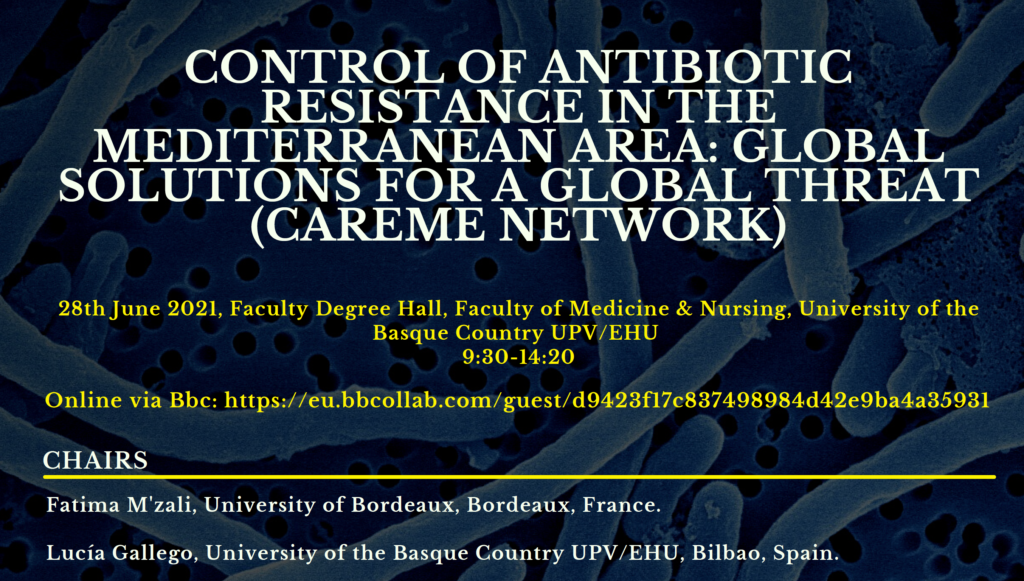
Researchers from the University of the Basque Country have recently attended the second meeting of the CAREME network (Control of Antibiotic Resistance in the Mediterranean Area: Global Solutions for a Global Threat), an international network dedicated to research in the city of Alexandria (Egypt). of resistance to antibiotics.

The network, directed by professors Lucía Gallego, professor of Medical Microbiology at the UPV/EHU, and Fátima M’Zali, professor at the University of Bordeaux, held its first meeting in June 2021, at the Faculty of Medicine and Nursing in the Basque public university, within an initiative financed by the Euskampus Foundation and framed in the strategic alliance of the UPV/EHU with the University of Bordeaux. This second meeting took place in Alexandria, specifically on the Abu Qir Campus of the Arab Academy for Science, Technology & Maritime Transport, an institution with which the UPV/EHU has signed a collaboration agreement.

The CAREME network aims to be a meeting point to create an international consortium that effectively develops solutions aimed at mitigating the devastating effects of antibiotic resistance on the health and economy of Mediterranean countries. Today, antibiotic resistance is one of the greatest threats to global health and is putting Medicine as we know it at risk. The post-antibiotic era is already a reality: it produces a high rate of therapeutic failure and morbidity and mortality. If solutions are not found, it is estimated that by 2050 it will cause more deaths than cancer, also endangering the achievement of the Sustainable Development Goals. To make this panorama worse, the availability of new antibiotics is less and less, since very few molecules have been developed since the 1960s.

The global spread of multi-resistant bacteria that emerge in the hospital setting is a problem of the first order, but it is not limited to the clinical setting, since in recent years there have been numerous publications that describe resistant isolates also in other settings, such as the environment and the animal.

Investigadoras de la UPV /EHU asisten a la reunión de la red CAREME en Egipto, red de investigación dedicada a mitigar los efectos adversos de los antibióticos. 

Investigadoras de la Universidad del País Vasco han asistido recientemente en la ciudad de Alejandría (Egipto) a la segunda reunión de la red CAREME (Control of Antibiotic Resistance in the Mediterranean Area: Global Solutions for a Global Threat), red internacional dedicada a la investigación de la resistencia a los antibióticos.

La red, dirigida por las profesoras Lucía Gallego, profesora de Microbiología Médica de la UPV/EHU, y Fátima M’Zali, profesora de la Universidad de Burdeos, celebró su primera reunión en junio de 2021, en la Facultad de Medicina y Enfermería de la universidad pública vasca, dentro de una iniciativa financiada por la Fundación Euskampus y enmarcada en la alianza estratégica de la UPV/EHU con la universidad de Burdeos. Esta segunda reunión ha tenido lugar en Alejandría, concretamente en el Campus de Abu Qir de la Arab Academy for Science, Technology & Maritime Transport, institución con la que la UPV/EHU tiene firmado un convenio de colaboración.

La red CAREME pretende ser un punto de encuentro para crear un consorcio internacional que desarrolle con eficacia soluciones dirigidas a mitigar los efectos devastadores de la resistencia a los antibióticos en la salud y la economía de los países mediterráneos. Hoy día, la resistencia a los antibióticos es una de las mayores amenazas a la salud global y está poniendo en riesgo la Medicina tal y cómo la conocemos. La era postantibiótica es ya una realidad:  produce un alto índice de fracasos terapéuticos y morbimortalidad. Si no se encuentran soluciones, se calcula que para 2050 causará más muertes que el cáncer, poniendo en peligro además la consecución de los Objetivos de Desarrollo Sostenible. Para empeorar este panorama, la disponibilidad de nuevos antibióticos es cada vez menor, ya que muy pocas moléculas han sido desarrolladas desde los años 60. 

La diseminación global de bacterias multirresistentes que emergen en el ámbito hospitalario es un problema de primer orden, pero no se limita al espacio clínico, ya que en los últimos años son numerosas las publicaciones que describen aislamientos resistentes también en otros ámbitos, como el medioambiental y el animal. 
Deja una respuesta

Lo siento, debes estar conectado para publicar un comentario.

Basque Science Woman Women STEM STEAM
Dorleta Jimenez de Aberasturi
Raquel Esteban Terradillos y Daniel Marino Bilbao
Natalia Andrea Romero. GIIDEBA
Basque Science Woman Women STEM STEAM
Olena Kyzyma
Santa Águeda
José Ignacio Zudaire
Ildefonso Martínez de la Fuente, EHU-UPV
Rebeca Díez Alarcia
CIC ENERGIGUNE

Last News

  • Women in Science in the Basque Country: A Decade of Weaving Networks​
  • A pioneering genetic catalogue reveals hidden biodiversity in Basque estuary sediments
  • A mechanism that aggravates metabolic fatty liver disease discovered
  • Basque Country strengthens its position as a European hub for biosanitary innovation, neuroscience, and health technologies after two major achievements
  • University of Deusto to build its first academic satellite in partnership with Satlantis Microsats
  • Basque Government and IBM inaugurate the first ‘Quantum System Two’ in Europe, located in Donostia
  • Aurelio Mateo Alonso appointed Corresponding Academician of the Royal Academy of Sciences
  • Supercomputing in Industry and its importance
  • Deusto researchers develop a guide to help companies measure their social value and impact
  • Bilbao: IDOM announces its Science Factory
  • Basquevolt Chosen by the European Commission’s EIC Accelerator to Drive Solid-State Electrolyte Innovation and Production ‘Made in Basque Country’ for Europe
  • How the Basque Country Is shaping the observatory will change the understanding of the universe
  • Amalur EIS: A New Platform for Evaluating Industrial Emissions Across Europe
  • New advances in the search for new medications
  • MINDSENS: Early Alzheimer’s detection with a drop of blood
  • EHU: Heart disease, cancer or Parkinson’s risk development could be found through saliva analysis
  • Clean Hydrogen Generation from Seawater
  • Neuron-like cells made from human dental stem cells
  • GLUTLEARN, an educational programme for people following a gluten-free diet
  • European cities are lagging behind in adapting to climate change.
  • LAPlab: Deciphering the secrets of language
  • MEPRO Medical Reproductive Solutions, technology with purpose: innovating in male fertility
  • The Basque Country will install the first ‘IBM Quantum System Two’ in Europe, in Donostia – San Sebastián
  • An environmentally friendly and economical high-power energy storage system from pine biomass
  • The fascinating invention to detect dark matter in Jupiter’s interior
  • Pilar Nicolás, researcher at the UPV/EHU, participates in the creation of the largest European DNA catalogue
  • Etxetar, the world’s leading engineering company in advanced production systems for combustion engine and electric vehicle parts
  • Pollinator diversity in urgent need of protection for ensure ecosystems function properly
  • Antonio Gómez Muñoz, named Honorary Member of the Sphingolipid Club
  • The Basque Country, a benchmark in neruromorphic technology
  • Bilbao presents its STEAM education strategy at the I European Congress in Göteborg
  • ‘Emakumeak Zientzian’: Basque Women in Science
  • Golden Gait helps Parkinson’s patients improve mobility
  • From Lab to Field: The startup revolutionizing sports nutrition
  • Casilda Iturrizar: A feminist legacy rescued by science
  • BILBAO HOSTS THE VII RSME CONGRESS OF YOUNG RESEARCHERS
  • The level of agreement among different nutrition labels worldwide is very low
  • Polykey provides polymer solutions for a more sustainable future
  • DIVE Medical helps diagnose visual and neurocognitive problems in childhood
  • Asparia Glycomics leads the market in glycans, essential molecules for diagnosing and curing multiple diseases
  • Jaime Martin, the Basque scientist who is researching organic solar cells in Galicia
  • One hundred and sixty-two people from the University of the Basque Country, among the most influential in the world of science
  • The Basque Hydrogen Corridor, one of the world’s main H2 valleys
  • Giideba, innovative technology to prevent and treat bedsores and venous thrombosis
  • This is LUR-1, the first 100% Basque satellite launched by AVS
  • AI detects cancer and viral infections with nanometre precision
  • Qassay develops medical readers for diagnosing diseases such as cancer or diabetes
  • 3R Technology to build lighter and more sustainable trains
  • Innitius: an AI capable of improving the health and quality of life of pregnant women and newborns
  • Uhinak: The international Congress is set to be held for the 6th time, addressing the rapid unprecedented oceanic change and its impact on the coast

Encuéntranos

Dirección
Calle Principal, 123
Madrid, 28000

Horas
Lunes a viernes: de 9:00 a 17:00 h.
Sábado y domingo: de 11:00 a 15:00 h.

  • enero 20, 2026 by BasqueScience Women in Science in the Basque Country: A Decade of Weaving Networks​
  • enero 12, 2026 by BasqueScience A pioneering genetic catalogue reveals hidden biodiversity in Basque estuary sediments
  • diciembre 16, 2025 by BasqueScience A mechanism that aggravates metabolic fatty liver disease discovered
  • diciembre 5, 2025 by BasqueScience Basque Country strengthens its position as a European hub for biosanitary innovation, neuroscience, and health technologies after two major achievements
  • noviembre 8, 2025 by BasqueScience University of Deusto to build its first academic satellite in partnership with Satlantis Microsats

SCIENCE

The scientific production in the Basque Country is very relevant. The educational and university environment, the business world, entities and institutions make up an important ecosystem here that is committed to the future.

TECHNOLOGY

Technologies and good methodologies facilitate a greater and better advancement of Science. Science and Technology come together to improve the quality of life of People, to build a better society..

INNOVATION

The Basque institutional strategies for Science, Technology and Innovation work to position our region among the most advanced European regions in innovation, with an excellent Human Development Index.