
Saltar al contenido
Basque Science logo
Menú
  • Home
  • About basque.SCIENCE
  • who`s who
  • Send us your proposals
Menú
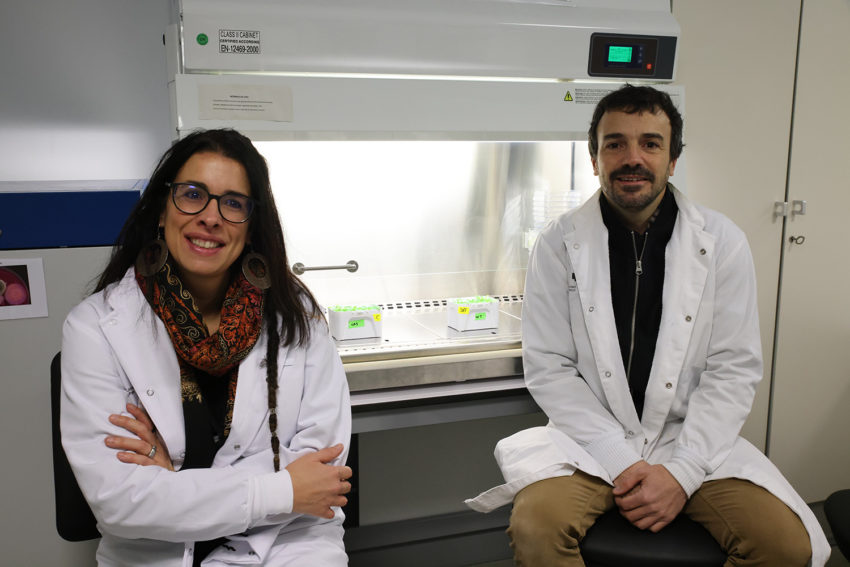
Raquel Esteban Terradillos y Daniel Marino Bilbao

Discovered the first metabolic pathway in production of nitric oxide from amino acids in plants

Publicada el enero 30, 2024mayo 20, 2024 por Estíbaliz Pérez de la Torre

The Public University of Navarra (UPNA), in collaboration with the University of the Basque Country (UPV/EHU), is leading a pioneering research that uncovers the first metabolic pathway responsible for the production of nitric oxide (NO) in plants from amino acids, highlighting the importance of oxymes, a type of chemical compounds, in this process. Recently published in the scientific journal «Molecular Plant», the study reveals that the Balkan region was a cosmopolitan border of ancient Rome, and that Slavic migration from the sixth century onwards constitutes between 30% and 60% of the ancestry of today’s Balkan peoples.

The work, conducted by researchers from the UPNA IMAB Institute, together with scientists from UPV/EHU and the University of Tubinga (Germany), highlights the relevance of nitric oxide in the signaling of vital functions in living organisms, regulating crucial aspects such as cardiovascular health and athletic performance. Unlike animals, plants have predominantly used a reductive process to synthesize nitric oxide, and until now no specific metabolic pathways had been identified to produce it from amino acids and ammonia.

Research has discovered an alternative route, using enzymes called peroxidases over chemical compounds such as oxymes, which promises to improve plant tolerance to stress, such as drought, and could influence plant nutrition in the context of sustainable fertilizer use. In addition, the studied aldoximas show a potential inductive effect on lateral root growth, which could improve plant resistance under stress conditions.

This finding not only has implications for plant biology and agriculture, but also opens up new ways of research in human health. The participation of aldoximes in the production of nitric oxide may have repercussions in cardiovascular disease research and in the design of new drugs. In addition, the indolacetaldehyde molecule, related to oxymes, has structural similarities with the hormones of happiness and sleep in humans, as well as with the synthesis of beneficial hormones by digestive bacteria, suggesting possible applications in understanding the signaling between the human body and intestinal bacteria.
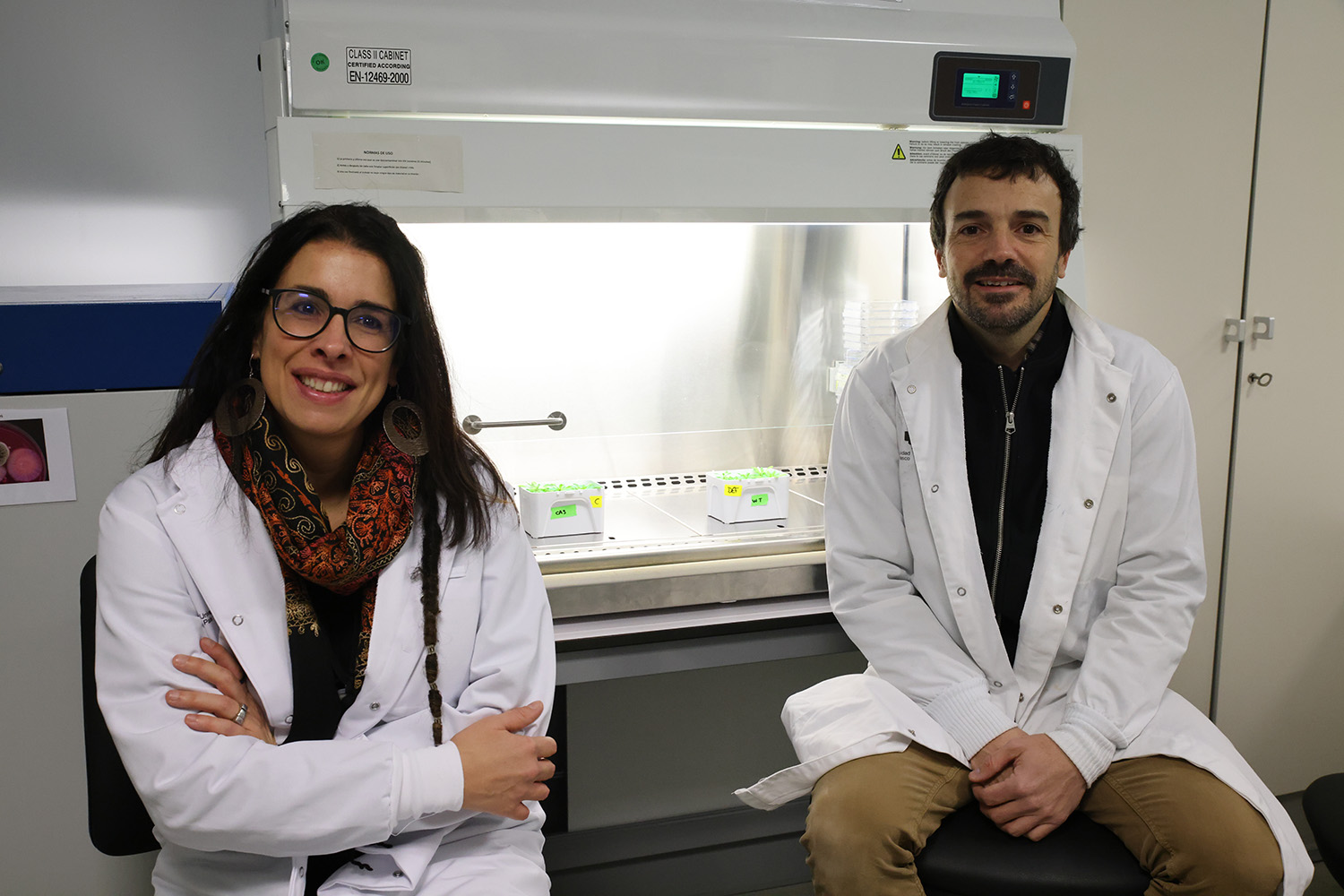
Raquel Esteban Terradillos y Daniel Marino Bilbao

Descubren la primera vía metabólica en la producción de óxido nítrico a partir de aminoácidos en plantas

La Universidad Pública de Navarra (UPNA), en colaboración con la Universidad del País Vasco (UPV/EHU), lidera una investigación pionera que desvela la primera vía metabólica responsable de la producción de óxido nítrico (NO) en plantas a partir de aminoácidos, destacando la importancia de las oximas, un tipo de compuestos químicos, en este proceso. Publicado recientemente en la revista científica «Molecular Plant», el estudio revela que la región de los Balcanes fue una frontera cosmopolita de la antigua Roma, y que la migración eslava a partir del siglo VI constituye entre el 30% y el 60% de la ascendencia de los pueblos balcánicos actuales.

El trabajo, realizado por investigadores del Instituto IMAB de la UPNA, en conjunto con científicos de la UPV/EHU y de la Universidad de Tubinga (Alemania), destaca la relevancia del óxido nítrico en la señalización de funciones vitales en organismos vivos, regulando aspectos cruciales como la salud cardiovascular y el rendimiento deportivo. Contrariamente a los animales, las plantas han utilizado predominantemente un proceso reductivo para sintetizar óxido nítrico, y hasta ahora no se habían identificado vías metabólicas específicas para producirlo a partir de aminoácidos y amonio.

La investigación ha descubierto una vía alternativa, utilizando enzimas llamadas peroxidasas sobre compuestos químicos como las oximas, que promete mejorar la tolerancia de las plantas al estrés, como la sequía, y podría influir en la nutrición vegetal en el contexto del uso sostenible de fertilizantes. Además, las aldoximas estudiadas muestran un potencial efecto inductor en el crecimiento de raíces laterales, lo que podría mejorar la resistencia de las plantas en condiciones de estrés.

Este hallazgo no solo tiene implicaciones en la biología vegetal y la agricultura, sino que también abre nuevas vías de investigación en la salud humana. La participación de las aldoximas en la producción de óxido nítrico puede tener repercusiones en la investigación de enfermedades cardiovasculares y en el diseño de nuevos fármacos. Además, la molécula indolacetaldoxima, relacionada con las oximas, presenta similitudes estructurales con las hormonas de la felicidad y del sueño en humanos, así como con la síntesis de hormonas beneficiosas por bacterias digestivas, lo que sugiere posibles aplicaciones en la comprensión de la señalización entre el cuerpo humano y las bacterias intestinales.

INFO: https://www.ehu.eus/es/-/descubren-la-primera-via-metabolica-en-la-produccion-doxido-nitrico-a-partir-de-aminoacidos-en-plantas

Basque Science Woman Women STEM STEAM
José Ignacio Zudaire
Ildefonso Martínez de la Fuente, EHU-UPV
Raquel Esteban Terradillos y Daniel Marino Bilbao
Dorleta Jimenez de Aberasturi
Olena Kyzyma
CIC ENERGIGUNE
Natalia Andrea Romero. GIIDEBA
Santa Águeda
Rebeca Díez Alarcia
Basque Science Woman Women STEM STEAM

Last News

  • Women in Science in the Basque Country: A Decade of Weaving Networks​
  • A pioneering genetic catalogue reveals hidden biodiversity in Basque estuary sediments
  • A mechanism that aggravates metabolic fatty liver disease discovered
  • Basque Country strengthens its position as a European hub for biosanitary innovation, neuroscience, and health technologies after two major achievements
  • University of Deusto to build its first academic satellite in partnership with Satlantis Microsats
  • Basque Government and IBM inaugurate the first ‘Quantum System Two’ in Europe, located in Donostia
  • Aurelio Mateo Alonso appointed Corresponding Academician of the Royal Academy of Sciences
  • Supercomputing in Industry and its importance
  • Deusto researchers develop a guide to help companies measure their social value and impact
  • Bilbao: IDOM announces its Science Factory
  • Basquevolt Chosen by the European Commission’s EIC Accelerator to Drive Solid-State Electrolyte Innovation and Production ‘Made in Basque Country’ for Europe
  • How the Basque Country Is shaping the observatory will change the understanding of the universe
  • Amalur EIS: A New Platform for Evaluating Industrial Emissions Across Europe
  • New advances in the search for new medications
  • MINDSENS: Early Alzheimer’s detection with a drop of blood
  • EHU: Heart disease, cancer or Parkinson’s risk development could be found through saliva analysis
  • Clean Hydrogen Generation from Seawater
  • Neuron-like cells made from human dental stem cells
  • GLUTLEARN, an educational programme for people following a gluten-free diet
  • European cities are lagging behind in adapting to climate change.
  • LAPlab: Deciphering the secrets of language
  • MEPRO Medical Reproductive Solutions, technology with purpose: innovating in male fertility
  • The Basque Country will install the first ‘IBM Quantum System Two’ in Europe, in Donostia – San Sebastián
  • An environmentally friendly and economical high-power energy storage system from pine biomass
  • The fascinating invention to detect dark matter in Jupiter’s interior
  • Pilar Nicolás, researcher at the UPV/EHU, participates in the creation of the largest European DNA catalogue
  • Etxetar, the world’s leading engineering company in advanced production systems for combustion engine and electric vehicle parts
  • Pollinator diversity in urgent need of protection for ensure ecosystems function properly
  • Antonio Gómez Muñoz, named Honorary Member of the Sphingolipid Club
  • The Basque Country, a benchmark in neruromorphic technology
  • Bilbao presents its STEAM education strategy at the I European Congress in Göteborg
  • ‘Emakumeak Zientzian’: Basque Women in Science
  • Golden Gait helps Parkinson’s patients improve mobility
  • From Lab to Field: The startup revolutionizing sports nutrition
  • Casilda Iturrizar: A feminist legacy rescued by science
  • BILBAO HOSTS THE VII RSME CONGRESS OF YOUNG RESEARCHERS
  • The level of agreement among different nutrition labels worldwide is very low
  • Polykey provides polymer solutions for a more sustainable future
  • DIVE Medical helps diagnose visual and neurocognitive problems in childhood
  • Asparia Glycomics leads the market in glycans, essential molecules for diagnosing and curing multiple diseases
  • Jaime Martin, the Basque scientist who is researching organic solar cells in Galicia
  • One hundred and sixty-two people from the University of the Basque Country, among the most influential in the world of science
  • The Basque Hydrogen Corridor, one of the world’s main H2 valleys
  • Giideba, innovative technology to prevent and treat bedsores and venous thrombosis
  • This is LUR-1, the first 100% Basque satellite launched by AVS
  • AI detects cancer and viral infections with nanometre precision
  • Qassay develops medical readers for diagnosing diseases such as cancer or diabetes
  • 3R Technology to build lighter and more sustainable trains
  • Innitius: an AI capable of improving the health and quality of life of pregnant women and newborns
  • Uhinak: The international Congress is set to be held for the 6th time, addressing the rapid unprecedented oceanic change and its impact on the coast

Encuéntranos

Dirección
Calle Principal, 123
Madrid, 28000

Horas
Lunes a viernes: de 9:00 a 17:00 h.
Sábado y domingo: de 11:00 a 15:00 h.

  • enero 20, 2026 by BasqueScience Women in Science in the Basque Country: A Decade of Weaving Networks​
  • enero 12, 2026 by BasqueScience A pioneering genetic catalogue reveals hidden biodiversity in Basque estuary sediments
  • diciembre 16, 2025 by BasqueScience A mechanism that aggravates metabolic fatty liver disease discovered
  • diciembre 5, 2025 by BasqueScience Basque Country strengthens its position as a European hub for biosanitary innovation, neuroscience, and health technologies after two major achievements
  • noviembre 8, 2025 by BasqueScience University of Deusto to build its first academic satellite in partnership with Satlantis Microsats

SCIENCE

The scientific production in the Basque Country is very relevant. The educational and university environment, the business world, entities and institutions make up an important ecosystem here that is committed to the future.

TECHNOLOGY

Technologies and good methodologies facilitate a greater and better advancement of Science. Science and Technology come together to improve the quality of life of People, to build a better society..

INNOVATION

The Basque institutional strategies for Science, Technology and Innovation work to position our region among the most advanced European regions in innovation, with an excellent Human Development Index.