
AI developed at CIC bioGUNE identifies the SRSF1 gene, which can rejuvenate human cells and extend lifespan in animal models
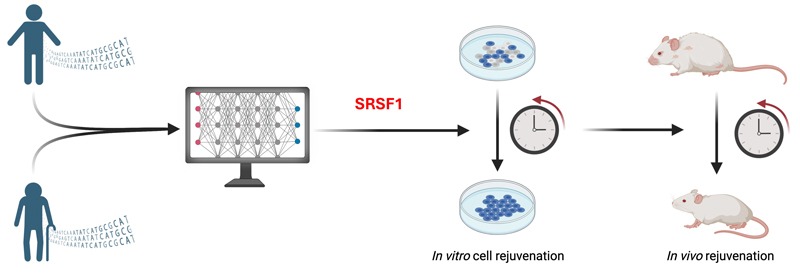
An international team led from the Basque Country has developed an artificial intelligence tool capable of predicting biological age and identifying genes with the potential to rejuvenate human cells. The research, led by CIC bioGUNE, the Luxembourg Centre for Systems Biomedicine (LCSB) and Harvard Medical School, has identified the SRSF1 gene as a promising candidate to counter molecular changes associated with ageing.
The study focuses on biological age, which reflects the changes that cells and tissues undergo over time, rather than relying solely on a person’s chronological age. To measure it, researchers created a transcriptomic age predictor based on machine learning, trained on gene-expression data obtained through RNA sequencing from skin cells of donors ranging from childhood to old age.
The tool analyses which genes are active and to what extent, detecting molecular patterns linked to ageing. Using it, the team systematically examined dozens of candidate genes to determine which could shift aged cells towards a more youthful molecular profile.
Among all the candidates analysed, SRSF1 stood out. This gene encodes a protein involved in RNA processing and splicing, essential processes for proper cell function.
The researchers found that SRSF1 expression is higher in younger cells. When its activity was increased in aged human cells, the cells altered their gene-expression patterns and adopted a significantly younger molecular state.
A key aspect of the finding is that this rejuvenation did not cause the cells to lose their identity, one of the main obstacles associated with other cellular reprogramming approaches. According to Professor Antonio del Sol, leader of the computational biology groups at the LCSB and CIC bioGUNE in Bilbao, this opens the door to rejuvenation strategies that preserve cellular identity and function.
To determine whether the effect extended beyond the laboratory, the team collaborated with the group of Professor George Church at Harvard Medical School. In aged worm and mouse models, inducible activation of SRSF1 slowed the progression of frailty and was associated with an increase of up to 14% in median lifespan.
In addition to extending lifespan, the intervention improved several measures of biological function, including tissue repair, resilience and physiological performance. These results suggest that SRSF1 could help maintain health during old age, rather than simply extending longevity.
The research demonstrates the value of combining computational biology developed in the Basque Country with experimental validation carried out at Harvard. The study was led by CIC bioGUNE, a biomedical research centre that is part of the Basque Research & Technology Alliance (BRTA), together with the LCSB and Harvard Medical School.
The study, published in the journal Nature Aging, is titled “Transcriptomic reprogramming screen identifies SRSF1 as a regulator of aging” and was authored by, among others, Alexandru M. Pleșa, Sascha Jung, Helen H. Wang, Fawad Omar, Michael Shadpour, David Choy Buentello, Maria C. Perez-Matos, Naftali Horwitz, George Cai, Zhen Kai Ngian, Carol Magalhaes, Amy J. Wagers, William B. Mair, Antonio del Sol and George M. Church.
The authors stress that SRSF1 is only the beginning. The strategy developed will allow searches to be expanded to more genes, biological pathways and cell types, accelerating the identification of interventions that promote healthy ageing.
In the medium term, this approach could help design tailored therapies for the cell types most affected by age-related diseases. For the Basque Country, the finding reinforces the role of CIC bioGUNE and the Basque scientific community in cutting-edge biomedical research.
Edited by Jon Erramun Arrue-Karazo