
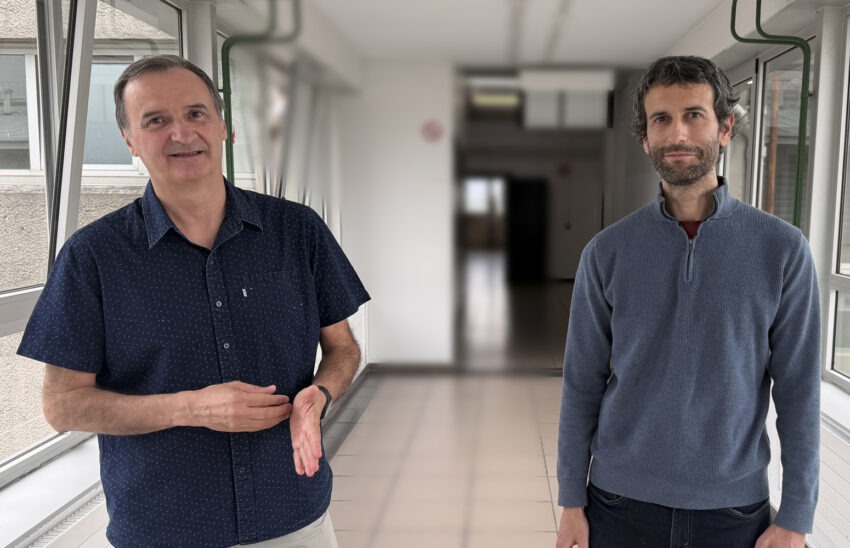
EHU researchers Urko Petralanda and Luis Elcoro contributed to an international collaboration that created a catalog of two-dimensional materials and their electronic and topological properties. Published in Science, the study analyzed nearly 9,000 atomically thin materials and identified more than 4,000 with topological characteristics.
A two-dimensional topological insulator does not conduct electricity through its interior, but allows current to flow without resistance along its edges. Even when cut into smaller pieces, each fragment retains insulating interiors and conducting edges—an extraordinary property with potential for future electronics and quantum technologies.
Topological Quantum Chemistry (TQC) has transformed the computational search for topological materials, but its rigorous application to 2D materials had been limited by their diverse crystal symmetries. The new study, Two-dimensional topological quantum chemistry and catalog of topological materials, extends TQC to single- and multi-layer materials.
The researchers analyzed 8,872 entries from computational materials databases and identified 4,073 topological materials or materials with obstructed atomic limits—systems with topological-like features under specific conditions. “Surprisingly, almost half of the materials are topological or obstructed,” said Petralanda.
The work expands the catalog of 2D topological or obstructed materials by roughly an order of magnitude. Because 2D materials can be stacked and occupy little space, they are expected to be essential building blocks for current and future electronics.
A companion Science study, 2D theoretically twistable material database, identifies materials suitable for twisted bilayers—structures that may exhibit exotic properties similar to those of “magic-angle” graphene, which can become unexpectedly insulating or superconducting.
The new framework links a material’s chemical composition and crystal symmetries to the topology of its electronic states. The team also developed crystallographic tables, analysis software, and a 2D Topological Materials Database, implemented in the free Bilbao Crystallographic Server so researchers can reproduce the results and analyze other 2D materials.
Like Lego pieces, these atomically thin layers can be stacked and twisted to create new platforms for exploring quantum phenomena. The catalog provides a foundation for selecting materials according to the physical effects researchers want to investigate.
Additional information
The two studies are the work of a joint theoretical and experimental team spanning more than a dozen institutions, including the University of the Basque Country (EHU), Princeton University, the Donostia International Physics Center (DIPC), the Max Planck Institute for the Structure and Dynamics of Matter, RWTH Aachen University, Sichuan Normal University, the University of Pennsylvania, the Max Planck Institute for Chemical Physics of Solids, Rice University, Cornell University, the Kavli Institute at Cornell for Nanoscale Science, Ludwig Maximilian University of Munich, and the Munich Center for Quantum Science and Technology, among others.
Edited by Jon Erramun Arrue-Karazo