
The distressing sensation of breathlessness—clinically defined as dyspnea—is one of the most distressing human experiences. Its systematic association with the terror of suffocation and the fear of dying means that its psychological impact often exceeds that of pain itself. Far from being a residual problem, it affects 10% of the adult population, rises to 30% among people over 65, and is present in more than 85% of heart failure diagnoses and in up to 90% of patients in the final phase of life.
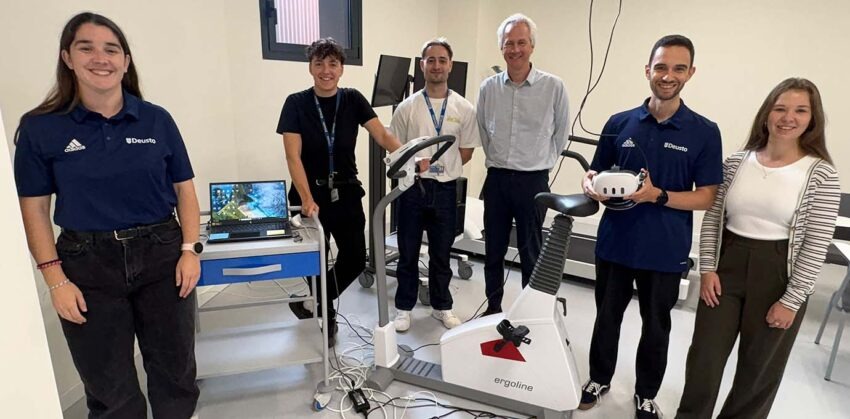
To address this global health challenge, the Deusto Physical TherapIker Research Group at the University of Deusto—a pioneer in Spain in this field—has taken a strategic step by partnering with Prof. Kyle Pattinson, a researcher at the University of Oxford and an international leading authority on the study of brain processing of breathing through functional magnetic resonance imaging. On 6 October, Prof. Pattinson met with the team led by Dr. Ane Arbillaga at the San Sebastián campus to launch a joint research protocol that will evaluate the use of virtual reality as a non-pharmacological therapeutic tool. For this study, the University of Oxford has provided specialized software designed to modify the central perception of dyspnea and directly intervene in the neural circuits involved in anxiety and anticipation.
In the words of Prof. Kyle Pattinson (University of Oxford): “Scientific research has shown us that breathlessness does not depend solely on the condition of the lungs or the heart. The brain operates predictively: expectations, mood, and previous experiences modify the way the nervous system processes breathing. Virtual reality allows us to intervene in that cognitive and emotional dimension to provide relief to people for whom traditional pharmacology is insufficient.”
Meanwhile, Dr. Ane Arbillaga, principal investigator of the Deusto Physical TherapIker team, highlights the urgency of changing the clinical perspective: “We can no longer continue treating dyspnea solely as a mechanical failure of the affected organ. It is a deeply biopsychosocial experience that isolates patients, generates hypervigilance, and destroys their autonomy. Addressing it with scientific rigor and cutting-edge technology is a medical obligation, but above all an ethical and humanitarian responsibility to those who suffer most.”
A knowledge network with impact
Professor Pattinson’s contributions have revolutionized respiratory neurobiology by demonstrating how the central nervous system processes sensations of chest tightness. The project launched in San Sebastián will apply this theoretical framework to validate personalized diagnoses and treatments through immersive technology, opening a path of hope for patients with chronic, neurological, or respiratory diseases.
Source: Deusto University, Edited by: Jon Erramun Arrue-Karazo