
Saltar al contenido
Basque Science logo
Menú
  • Home
  • About basque.SCIENCE
  • who`s who
  • Send us your proposals
Menú
Mikel Duran

CIC energigune drives the development of smart textiles capable of managing temperature and energy

Publicada el junio 21, 2026junio 21, 2026 por BasqueScience

The Basque centre is working on new flexible materials for applications in wearables, smart textiles, health, personal mobility and advanced thermal management.

The clothing of the future could do much more than protect us from the cold or heat. It could intelligently regulate temperature, adapt more effectively to the environment and even store thermal energy directly within the fabric itself. This is the objective CIC energiGUNE, the Basque centre specialising in energy storage and conversion, is working towards through the development of new flexible materials with applications in sport, health, personal mobility and flexible electronics.

The key lies in transforming the fabric itself into a functional material. Unlike traditional solutions based on rigid elements or external electrical systems, these new developments make it possible to integrate thermal management capabilities directly into fibres and flexible films, while maintaining comfort, lightness and ergonomics.

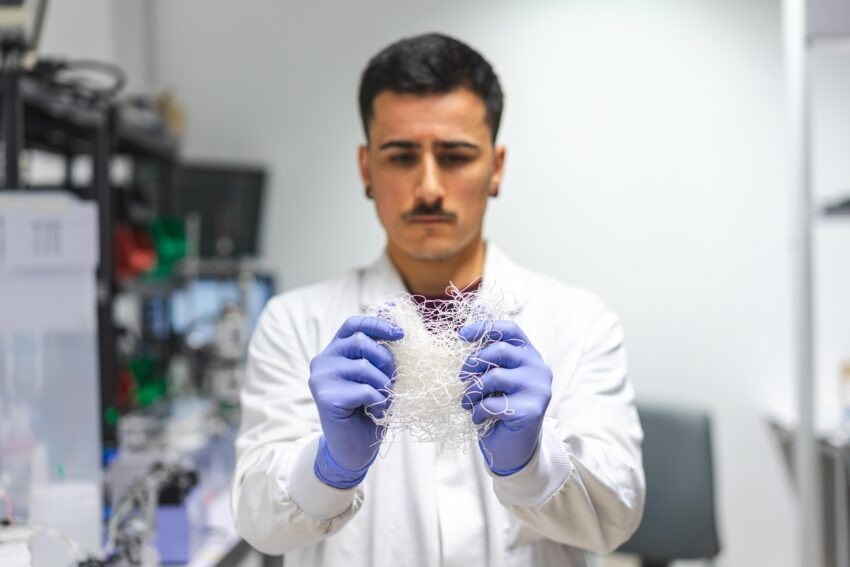
“We are moving from garments that simply provide insulation to much smarter and more adaptable textiles. The idea is for technology to stop being perceived as an added element and instead become a natural part of the material itself,” explains Mikel Duran, researcher at CIC energiGUNE in the field of thermal storage.

This type of solution could be applied to technical and sportswear capable of maintaining a more stable temperature, garments for extreme conditions, or textile systems aimed at health and wellbeing. In addition, these materials make it possible to reduce dependence on active electrical systems and improve the energy efficiency of products.

“In just a few years, we could see sportswear capable of helping to better regulate body temperature during exercise, avoiding heat or cold peaks and improving user comfort, with better adaptation to the body and without the need for heavy batteries. We could also see lighter and more comfortable winter garments capable of retaining heat for longer, or even textile covers and surfaces for electronic devices that help control overheating,” explains Beatriz Corral, Market Manager at CIC energiGUNE.

“This type of material aims to solve very real problems related to thermal comfort, energy efficiency and the integration of technology into everyday products, making functionality a natural part of the garments themselves,” adds Mikel Duran.

In this context, CIC energiGUNE is working on flexible phase change materials, known as Flexible PCMs, capable of absorbing, storing and releasing heat in a controlled way, while also adapting to different surfaces and geometries. The aim is to develop solutions that can realistically reach the market and be adapted to different industrial applications.

Advances in functional materials and flexible thermal management are therefore opening the door to a new generation of smart textiles in which comfort, efficiency and technological integration will become part of the fabric itself.

EBI Eficient Facilities
Ildefonso Martínez de la Fuente, EHU-UPV
Natalia Andrea Romero. GIIDEBA
Rebeca Díez Alarcia
Basque Science Woman Women STEM STEAM
Raquel Esteban Terradillos y Daniel Marino Bilbao
CIC ENERGIGUNE
Dorleta Jimenez de Aberasturi
Olena Kyzyma
José Ignacio Zudaire
Santa Águeda

Last News

  • The Basque Country, one of the Leading Quantum Ecosystems on the International Map
  • CIC energigune drives the development of smart textiles capable of managing temperature and energy
  • LUP: Artificial Intelligence and Computer Vision for Accessible Reading
  • Onkoreplica: We seek to accelerate the development of more effective therapies and improve cancer patients’ access to treatment
  • Ylenia Jabalera and Ujué Fresán awarded the 2026 L’Oréal–UNESCO ‘For Women in Science’ prizes
  • The power of the sea drives an innovative project on the Basque coast: Carnegie commitment to clean energy
  • Cyber ​​Surgery aims to introduce its spinal surgery robot in the United States
  • Universal Omics: “It’s time to use AI to research and treat metabolic diseases”
  • Oroi Boosts Growth in Central Europe with Acquisition of Kaleido VR
  • Glycoscience develops long-lasting natural repellents and sustainable biopesticides from the Basque Country
  • The first global tool to promote equality in ocean management is launched
  • Aleovitro, Basque Biotechnology for In Vitro Plant Cultivation
  • ‘Emakumeak Zientzian’ celebrates its tenth edition with a Manifesto for the Science of the Future
  • Basque Country Showcases Quantum Strategy to 14 European Regions at Innovation Leaders Meeting
  • Women in Science in the Basque Country: A Decade of Weaving Networks​
  • A pioneering genetic catalogue reveals hidden biodiversity in Basque estuary sediments
  • A mechanism that aggravates metabolic fatty liver disease discovered
  • Basque Country strengthens its position as a European hub for biosanitary innovation, neuroscience, and health technologies after two major achievements
  • University of Deusto to build its first academic satellite in partnership with Satlantis Microsats
  • Basque Government and IBM inaugurate the first ‘Quantum System Two’ in Europe, located in Donostia
  • Aurelio Mateo Alonso appointed Corresponding Academician of the Royal Academy of Sciences
  • Supercomputing in Industry and its importance
  • Deusto researchers develop a guide to help companies measure their social value and impact
  • Bilbao: IDOM announces its Science Factory
  • Basquevolt Chosen by the European Commission’s EIC Accelerator to Drive Solid-State Electrolyte Innovation and Production ‘Made in Basque Country’ for Europe
  • How the Basque Country Is shaping the observatory will change the understanding of the universe
  • Amalur EIS: A New Platform for Evaluating Industrial Emissions Across Europe
  • New advances in the search for new medications
  • MINDSENS: Early Alzheimer’s detection with a drop of blood
  • EHU: Heart disease, cancer or Parkinson’s risk development could be found through saliva analysis
  • Clean Hydrogen Generation from Seawater
  • Neuron-like cells made from human dental stem cells
  • GLUTLEARN, an educational programme for people following a gluten-free diet
  • European cities are lagging behind in adapting to climate change.
  • LAPlab: Deciphering the secrets of language
  • MEPRO Medical Reproductive Solutions, technology with purpose: innovating in male fertility
  • The Basque Country will install the first ‘IBM Quantum System Two’ in Europe, in Donostia – San Sebastián
  • An environmentally friendly and economical high-power energy storage system from pine biomass
  • The fascinating invention to detect dark matter in Jupiter’s interior
  • Pilar Nicolás, researcher at the UPV/EHU, participates in the creation of the largest European DNA catalogue
  • Etxetar, the world’s leading engineering company in advanced production systems for combustion engine and electric vehicle parts
  • Pollinator diversity in urgent need of protection for ensure ecosystems function properly
  • Antonio Gómez Muñoz, named Honorary Member of the Sphingolipid Club
  • The Basque Country, a benchmark in neruromorphic technology
  • Bilbao presents its STEAM education strategy at the I European Congress in Göteborg
  • ‘Emakumeak Zientzian’: Basque Women in Science
  • Golden Gait helps Parkinson’s patients improve mobility
  • From Lab to Field: The startup revolutionizing sports nutrition
  • Casilda Iturrizar: A feminist legacy rescued by science
  • BILBAO HOSTS THE VII RSME CONGRESS OF YOUNG RESEARCHERS

Encuéntranos

Dirección
Calle Principal, 123
Madrid, 28000

Horas
Lunes a viernes: de 9:00 a 17:00 h.
Sábado y domingo: de 11:00 a 15:00 h.

  • julio 9, 2026 by BasqueScience The Basque Country, one of the Leading Quantum Ecosystems on the International Map
  • junio 21, 2026 by BasqueScience CIC energigune drives the development of smart textiles capable of managing temperature and energy
  • mayo 20, 2026 by Izaro Alzaga LUP: Artificial Intelligence and Computer Vision for Accessible Reading
  • mayo 20, 2026 by Izaro Alzaga Onkoreplica: We seek to accelerate the development of more effective therapies and improve cancer patients' access to treatment
  • mayo 7, 2026 by Izaro Alzaga Ylenia Jabalera and Ujué Fresán awarded the 2026 L’Oréal–UNESCO ‘For Women in Science’ prizes

SCIENCE

The scientific production in the Basque Country is very relevant. The educational and university environment, the business world, entities and institutions make up an important ecosystem here that is committed to the future.

TECHNOLOGY

Technologies and good methodologies facilitate a greater and better advancement of Science. Science and Technology come together to improve the quality of life of People, to build a better society..

INNOVATION

The Basque institutional strategies for Science, Technology and Innovation work to position our region among the most advanced European regions in innovation, with an excellent Human Development Index.